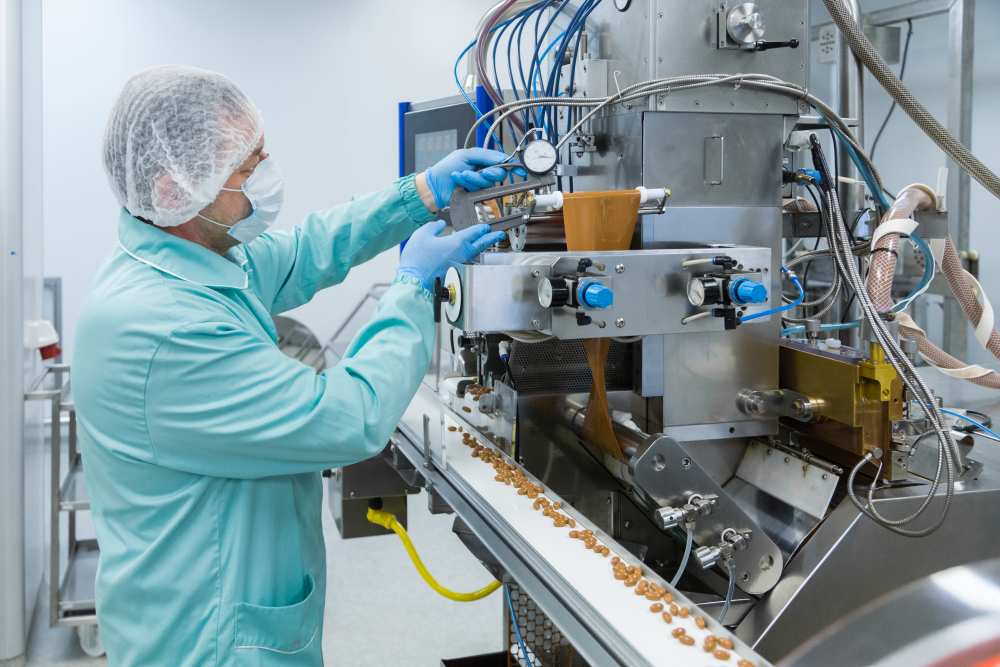
Filling machines and equipment form the operational backbone of every liquid and semi-liquid packaging line, and the efficiency of that backbone determines how cost-effectively a manufacturer can move product from production to shipping.
The Scope of Industrial Filling Equipment
The category of filling machines and equipment covers a wide range of formats, scales, and automation levels. At one end: a bench-top piston filler that an operator uses to fill sample vials. At the other end: a fully automated liquid packaging line that fills, caps, labels, weighs, and palletises thousands of units per hour without manual intervention. Between these extremes lies the practical territory where most industrial manufacturers operate – semi-automatic and automatic systems matched to medium-to-high production volumes.
The equipment types within this category include:
- Piston fillers: positive displacement piston mechanisms that deliver a fixed volume per fill cycle. Used for viscous products such as creams, sauces, adhesives, and thick chemicals.
- Peristaltic pump fillers: the product is moved by squeezing a flexible tube with rollers, creating a gentle fill action that suits shear-sensitive products
- Gear pump fillers: used for medium-to-high viscosity liquids where the positive displacement action of meshing gears delivers accurate, repeatable volumes
- Gravity fillers: the product head pressure above the fill valve drives the fill. Simple and low-maintenance for thin liquids.
- Weight-based fillers: load cells measure fill weight in real time, providing the most accurate fills for value products and regulated industries
Matching Equipment to Product and Container
Selecting filling machines and equipment appropriate for a specific application requires matching the fill technology to the product’s physical properties and the container format:
- Product viscosity: determines pump type and flow rate capability
- Product temperature: heat-sensitive products require temperature-controlled fill heads; hot-fill products require materials rated for high temperature exposure
- Container type: pails, drums, IBCs, cans, bottles, tubes, and bags each require different fill head configurations and conveying systems
- Fill accuracy requirement: tighter tolerances require more sophisticated sensing and control systems
A filling equipment supplier who understands this matching process adds genuine value to the procurement decision before any equipment is purchased.
The Efficiency Imperative
Efficiency in a packaging operation is measured at multiple levels. Machine efficiency – the throughput achievable when the machine is running – is the most visible metric. The line efficiency, which accounts for changeover time, cleaning time, downtime for maintenance and repairs, and the time lost to quality rejects from the inaccurate fills, actually determines production economics.
Industrial packaging machines that minimise changeover time, clean quickly and completely, require minimal maintenance-related downtime, and fill accurately enough to eliminate quality rejects deliver higher overall line efficiency than machines that optimise only for peak throughput rate.
Integration Across the Packaging Line
Filing machines rarely operate in isolation. In a complete packaging line, the filler receives containers from a denesting or infeed station, fills them to the specified weight or volume, and passes them to a capping or sealing station, a check weigher, a labelling system, and a palletiser. The filler must be compatible with adjacent equipment in terms of conveyor dimensions, timing, and control system integration.
“System thinking is what separates an efficient operation from a collection of individual machines.” – Lee Kuan Yew.
A packaging line that is designed as a system, with all components matched in capacity and integrated in control, performs better than one assembled from individually purchased components that happen to fit next to each other.
Automation as an Investment in Consistency
The primary case for automated filling equipment over semi-automatic or manual alternatives is consistency. An automated system fills every container at the same weight, at the same rate, with the same control parameters, regardless of operator fatigue, shift changes, or the variability that accumulates across a long production run. This consistency reduces quality failures, reduces product giveaway from overfill, and reduces the labour cost per unit at scale.
The capital cost of automation is recovered through these ongoing savings, typically within one to three years for medium-to-high volume applications.
Supplier and Support Considerations
Filling machinery and packaging equipment represent a significant capital investment that must perform reliably across years of production use. A supplier with local technical capability, spare parts availability, and service engineers who can reach a Singapore facility quickly provides an operational security that remote suppliers cannot match. Filling machines and equipment, properly selected, correctly integrated, and supported by a responsive local supplier, are what efficient industrial packaging operations are built on.